






JP EN

About the Association

The Energy Resource Aggregation Association (ERA) was established in October 2023 with the support of a wide range of stakeholders from diverse industries, including Specified Wholesale Supply Businesses (Aggregators) involved in the utilization of Distributed Energy Resources (DER), energy companies, manufacturers, system vendors, financial institutions, and experts.
In addition to demand response (DR) resources, whose utilization is rapidly expanding, ERA aims to promote the sound development of businesses that utilize DER—such as renewable energy sources including solar and wind power, which are indispensable for achieving carbon neutrality, and battery storage systems that are essential for the large-scale deployment of these resources. ERA also provides constructive policy recommendations, based on specialized expertise and the perspectives of business operators, regarding the development of electricity market mechanisms and regulatory frameworks that are essential for expanding the utilization of DER.
Through its activities, ERA contributes to the stability of electricity supply and demand, the enhancement of energy security, the realization of carbon neutrality, and the advancement of Japan’s economy and the well-being of its people.

Name (Abbreviation) Energy Resource Aggregation Association (ERA)
Address N&E BLD. 6F, 1-12-4 Ginza, Chuo-ku, Tokyo, Japan
Officers
  • Chair: E-Flow LLC
  • Vice Chair: Shizen Connect Inc.
  • Director: ENERES Co.,Ltd.
  • Director: DIGITAL GRID Corporation
  • Director: Enel X Japan K.K.
  • Director: Electric Power Development Co.,Ltd. (J-POWER)
  • Director: ElectroRoute Japan K.K.
  • Director: Tohoku Electric Power Co.,Inc.
  • Director: Sumitomo Corporation
  • Director: Marubeni Power Retail Corporation
Main Activities
  1. Research and planning for the expansion of DER utilization
  2. Information dissemination for the expansion of DER utilization
  3. Expression of opinions and requests to society and government
  4. Exchange and collaboration with related organizations
  5. Editing and publication of journals and related materials
  6. Other activities necessary to achieve the objectives of the Association
Date of Establishment October 6, 2023
Fiscal Year From April 1 to March 31
Contact Contact form

Background and Purpose

In recent years, a major wave of change has been sweeping through the energy sector. The key concepts driving this transformation are the three “Ds”: Digitalization, Decarbonization, and Decentralization.

  • Digitalization

    Digitalization
    Digitalization
  • Decarbonization

    De-Carbonization
    Decarbonization
  • Decentralization

    Decentralization
    Decentralization

These trends are driving a fundamental transformation of the traditional electricity industry.
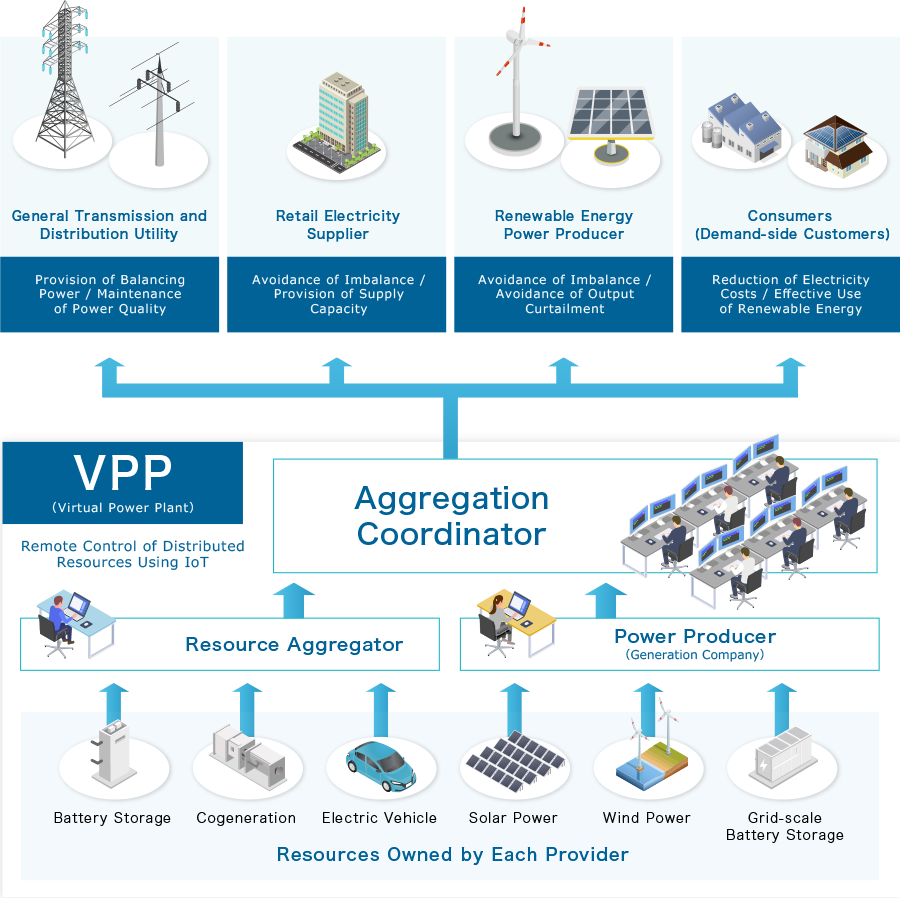
In terms of digitalization, a wide variety of devices used throughout society are increasingly being connected through IoT technologies, making remote monitoring and control much easier. In the energy sector as well, Virtual Power Plants (VPPs), which enable the integrated remote control of customer-owned equipment, are steadily gaining traction.

In terms of decarbonization, to reduce emissions of greenhouse gases such as CO₂—one of the causes of global warming—a transition is underway from conventional thermal power generation to renewable energy sources such as solar and wind power that do not emit CO₂.

In terms of decentralization, in response to these trends, the utilization of distributed energy resources is expanding, shifting away from the traditional large-scale, centralized model.

Shift from Large-scale, Centralized
to Distributed Systems

Large-scale Power Sources

Thermal power generation

Distributed Power Sources

  • Wind power
  • Solar power
  • Battery
    storage systems
  • Eco
    Cute
  • ENE
    FARM
  • Electric vehicles (EVs)

Since the introduction of the Feed-in Tariff (FIT) scheme in 2012, the deployment of renewable energy sources such as solar and wind power has expanded steadily. As renewable deployment has increased, thermal power plants have seen declining utilization rates, and many units have been suspended or decommissioned. Combined with recent abnormal weather and natural disasters such as earthquakes, tight electricity supply–demand conditions have occurred frequently in recent years. Furthermore, as thermal capacity continues to decrease, there are growing concerns that Japan may face a shortage of balancing resources necessary to maintain the supply–demand balance in the future.

Amid these rapid and far-reaching changes, Distributed Energy Resources (DER), which embody the three “Ds,” are expected to play an increasingly important role in the energy sector. Recognizing the importance of DER, the government, in April 2022, defined businesses that conduct market transactions using DER as “Specified Wholesale Supply Businesses” and moved them to a licensing regime (the aggregator license) similar to those for power generation businesses and retail electricity businesses. Aggregators assume responsibilities equivalent to those of power generators, including submitting supply plans and ensuring system security, and will play a key role in supporting the electricity sector.

However, when electricity trading markets and various operational frameworks are introduced or revised, the institutional design has often been based on conventional power sources such as thermal generation. As a result, current market rules and operating frameworks do not fully reflect the characteristics of DER, which have emerged as important new resources in the electricity sector. To further expand DER utilization, ERA will consolidate insights and perspectives from a wide range of participating stakeholders. Based on specialized expertise, ERA will develop constructive policy recommendations aimed at improving and strengthening the regulatory and institutional frameworks of the electricity sector.